WordPress is the most intuitive content editor on the internet. It is also a massive liability when its frontend is exposed to the public web.
I have spent over two decades building digital infrastructure, and I constantly see business owners forced into a false choice. They either suffer the bloat, slow load times, and constant security patching of a traditional WordPress monolith, or they migrate to a blazing-fast static site builder but force their non-technical team to write articles in raw markdown code.
At DYGYX, we refuse to compromise. We use a Headless WordPress and Astro architecture. It is the definitive way to build a modern, high-performance content platform in 2026.
Here is why decoupling your backend from your frontend is a massive win for your business.
The problem with the monolith
In a traditional setup, your content database and your public website are tangled together in one massive application.
Every time a visitor clicks a link to read your blog, your server has to boot up PHP, query a MySQL database, fetch the content, fetch the theme files, run dozens of plugins, and stitch it all together into an HTML page on the fly.
It is incredibly inefficient. It leads to terrible Time to First Byte (TTFB) scores, and it leaves your database permanently connected to the public internet, acting as a magnet for automated attacks and malware.
The headless solution
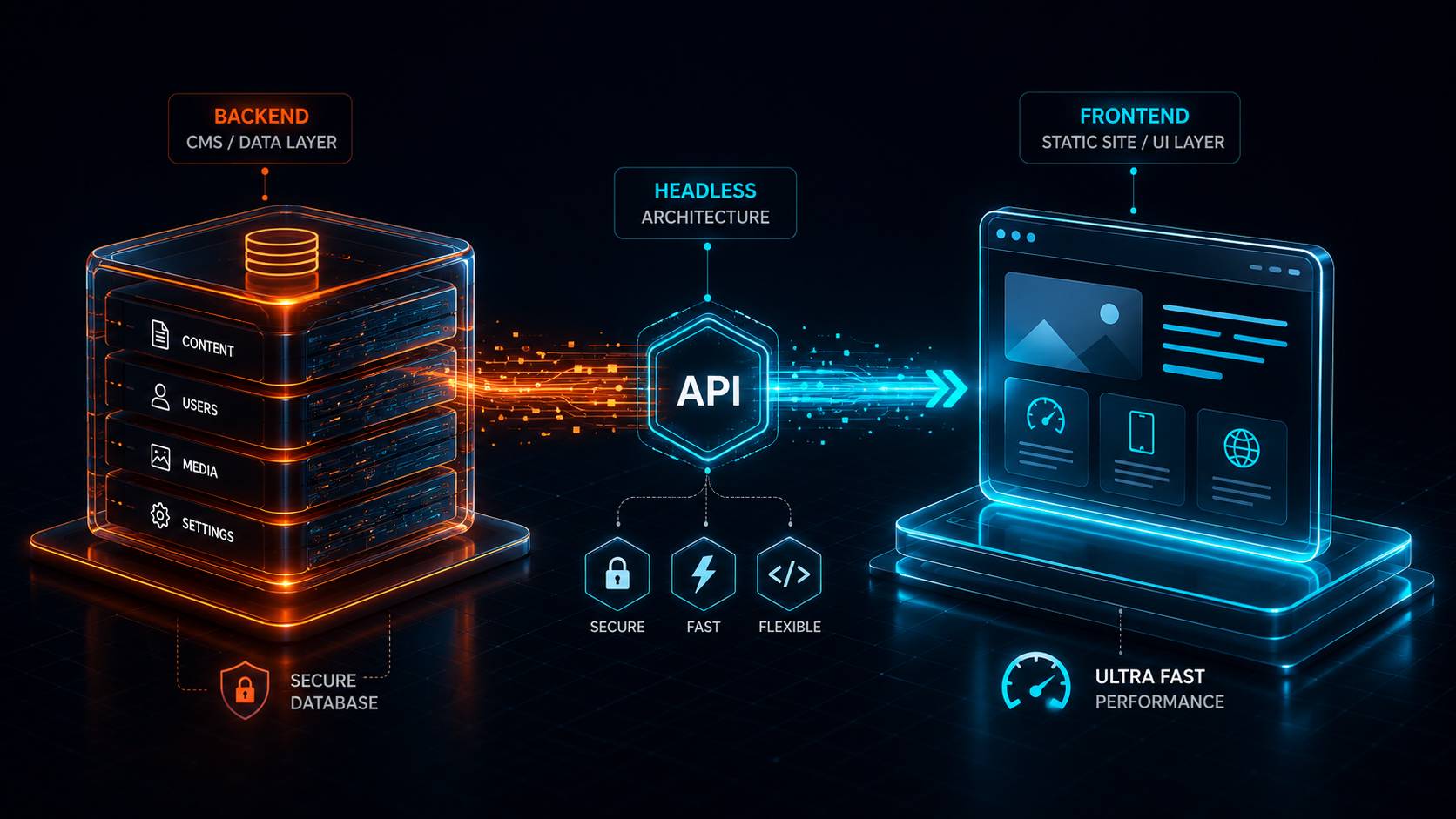
A “headless” architecture takes a chainsaw to the monolith. We completely sever the WordPress backend from the public-facing website.
- The Backend (WordPress): We lock WordPress down on a hidden, private URL. We use it purely as a database and a writing interface. The familiar Gutenberg editor, media library, and SEO tools remain exactly the same.
- The Frontend (Astro): We build the actual website using Astro, a modern static site generator.
- The Bridge (The Webhook): When we click “Publish” in WordPress, a silent webhook pings our global edge network (Cloudflare). Astro reaches into WordPress via a secure API, downloads the new article, bakes it into a pure, static HTML file, and pushes it to servers worldwide.
Why this architecture wins
Unbreakable Security You cannot hack a server that has nothing to hack. Because Astro generates flat HTML files, there is no database connected to your live website. There is no wp-admin login page for bots to brute-force. There are no vulnerable PHP plugins running on the frontend. The attack surface is completely eliminated.
Zero Editorial Friction Most static sites require you to manage content in a code editor. With a headless setup, your writers and marketers never have to look at a line of code. They write in the visual WordPress editor they already know. They generate alt text, set featured images, and write meta descriptions using SEOPress, just like they always have.
Answer Engine Optimization (AEO) AI search tools like Perplexity and Google’s AI Overviews struggle to parse the heavy, nested <div> blocks generated by traditional WordPress page builders. Astro outputs pristine, semantic HTML with zero JavaScript bloat. When an Answer Engine crawls a headless Astro site, the signal-to-noise ratio is perfect. It finds your facts, your schema markup, and your expertise instantly.
Millisecond Performance Because the pages are pre-built and served directly from an edge cache, the load times are nearly instantaneous. You get perfect Core Web Vitals, sub-100ms TTFB, and a user experience that never stutters, regardless of how much traffic hits the site at once.
The bottom line
You do not have to choose between a fast website and an easy-to-use content manager. By pairing the world’s most popular editor with the world’s fastest static web framework, you get the absolute best of both worlds.
This is exactly how the DYGYX platform operates, and it is the architecture we recommend for businesses that treat their website speed and security as revenue-driving assets.
Curious if a headless architecture makes sense for your content operations? Message me on WhatsApp at @gtongco. I will take a look at your current setup and give you a straight answer.